Buyer’s checklist
Online registration or traditional reception: which fits your hotel?
Across the UAE, more properties are swapping paper forms and long queues for kiosk-based check-in with passport scanning. Before you commit to one model, run through the checks below so the decision matches your property size, guest profile and the way your front-of-house team actually works.

The shift
Why UAE hoteliers are rethinking the front desk
The UAE welcomed more than 30 million international overnight visitors in the last full tourism year, according to figures published by Dubai’s Department of Economy and Tourism. Big volumes mean big queues, especially in Dubai and Abu Dhabi where flight bank arrivals from Europe and Asia stack up between 6am and noon.
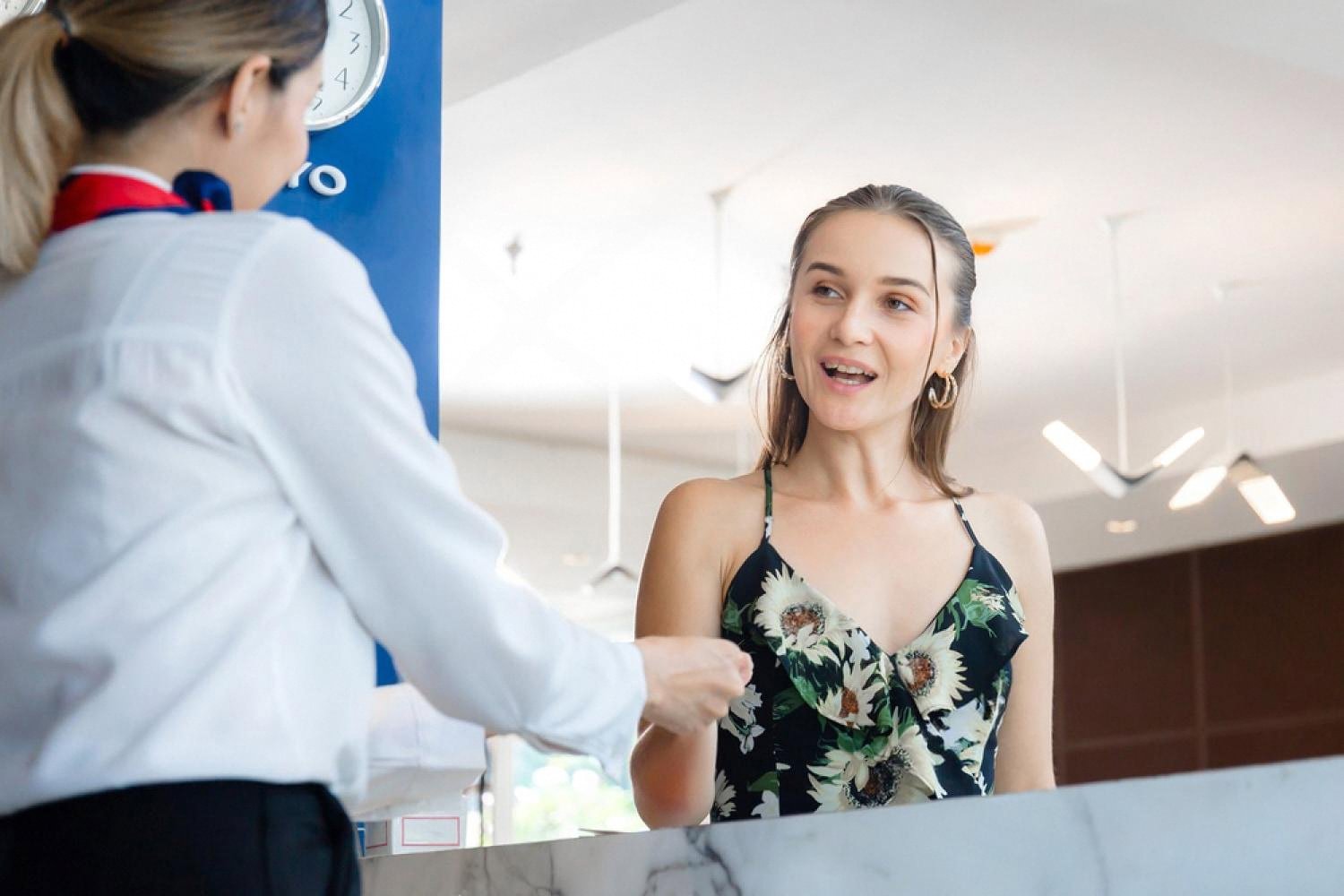
Traditional reception still works well for boutique properties where every guest gets a personal welcome. But for larger hotels, kiosks handle passport scans, form filling and room assignment automatically, freeing the front-desk team for genuine hospitality rather than data entry. The choice is not either-or, it is about matching the tool to the load.
The buyer’s checklist: 7 things to verify before you decide
- Peak-hour arrival volume. If you regularly see queues of six or more guests at check-in, a kiosk pays for itself in guest satisfaction alone.
- MoI and Tourism Police reporting. Confirm the system feeds guest data directly to the Ministry of Interior format required in your emirate. Manual re-entry defeats the purpose.
- Passport and Emirates ID capture quality. A reliable passport and ID scanner for hotels should read MRZ zones, chip data and Arabic-side details in one pass.
- PMS integration. The kiosk must talk to Opera, Protel, IDS or whatever property management system you already run. Otherwise you are just moving the bottleneck.
- Payment and pre-authorization. Check that the workflow handles AED card holds, corporate billing and multi-currency without pushing edge cases back to the desk.
- Language coverage. Arabic, English, Russian, Chinese and Hindi cover the vast majority of UAE arrivals. Fewer than that and you will still be translating at 2am.
- Fallback for VIPs and families. Even the best kiosk cannot replace a warm welcome for a suite guest travelling with three children. Plan a hybrid layout.

Deep dive
Why compliance is the trickiest item on the list
In the UAE, hotels are required to report guest arrivals to the authorities in a specific structured format, and the rules are enforced. A paper log or a receptionist typing details into a spreadsheet leaves gaps: mistyped passport numbers, missing visa pages, delayed submissions. During a Federal Authority for Identity, Citizenship, Customs and Port Security audit, those gaps become fines.
A kiosk with an integrated scanner captures the MRZ line, extracts fields with high accuracy and pushes the record to your PMS and to the government endpoint in one flow. That single audit trail is often the deciding factor for chains rolling out across multiple emirates.
Cost and staffing: what the numbers usually look like
Hardware and software costs vary widely by vendor, but the pattern is consistent. A single kiosk with a passport scanner, card reader and PMS licence typically sits in the mid-five-figure AED range once installed. Payback comes from three places at once.
- Labour rebalancing. One or two receptionist roles can be redirected to guest experience, upselling or concierge tasks.
- Reduced check-in time. Guests report shorter waits, which lifts review scores on Booking.com and TripAdvisor, which in turn lifts direct-booking share.
- Fewer data errors. No handwritten Vs mistaken for Us, no dropped visa stamps, no scrambling on audit day.
A useful reference point: self-service kiosks in adjacent industries like airlines and quick-service restaurants have consistently shown double-digit reductions in service time. Hotels see similar patterns once the workflow is tuned.
Side-by-side: which model fits which property
Small boutique (under 40 keys)
Stick with traditional reception. The personal welcome is part of the product, and volumes rarely justify kiosk hardware.
Mid-size city hotel (80 to 250 keys)
Hybrid works best. One or two kiosks for corporate and repeat guests, staffed desks for families and walk-ins.
Large resort or airport hotel (300+ keys)
Full kiosk deployment. Peak arrivals overwhelm any staffed line, and guests strongly prefer to skip the queue after a long flight.
Reference table: comparing the two approaches
| Factor | Traditional reception | Kiosk-based online registration |
|---|---|---|
| Average check-in time | 4 to 8 minutes per guest | 60 to 120 seconds per guest |
| Staff needed at peak | 3 to 5 agents | 1 host plus 2 to 4 kiosks |
| Data accuracy | Depends on the agent | MRZ and chip capture, near zero errors |
| Personal welcome | Strong by default | Requires a dedicated lobby host |
| Setup cost (per station) | Low, mostly furniture and a PC | Higher, hardware plus software licence |
| Best fit | Boutique, luxury, resort villas | City hotels, airport hotels, large chains |
The takeaway
There is no single right answer, only the right fit
If your lobby is calm and your guests expect a name-at-the-door welcome, keep the classic reception and invest in your people. If your peak hours look like an airport queue, kiosks with passport scanning will lift both guest scores and staff morale. Most UAE hoteliers end up somewhere in the middle, and that hybrid is usually the smartest place to land.
Frequently asked questions
Is kiosk-based online registration legal for hotels in the UAE?
Yes, provided the system captures the guest data required by the Ministry of Interior and the local tourism authority in your emirate, and reports it in the expected format. Reputable kiosk vendors serving the UAE market build these integrations in by default. Always ask for a signed compliance statement before you sign the purchase order.
Do guests actually prefer kiosks over a receptionist?
It depends on the guest and the moment. Business travellers arriving late, repeat guests and tech-comfortable visitors overwhelmingly prefer the speed of a kiosk. Families, first-time visitors to the UAE and luxury-segment guests still value a human welcome. The best deployments give both options in the same lobby.
What happens if a passport scanner cannot read a document?
Modern hotel scanners fall back through several read modes: MRZ, chip, visual OCR and manual photo capture. If all fail, the kiosk routes the guest to a staffed desk with the partial data already filled in. That handoff should take seconds, not minutes.
This is exactly why every deployment should keep at least one staffed position available at all times.
How long does a full kiosk rollout usually take?
For a single property, expect four to eight weeks from contract to go-live. That covers PMS integration, government reporting endpoints, hardware delivery, staff training and a soft-launch period. Multi-property rollouts are typically staged one hotel at a time so lessons from the first site improve the next.
Can we start with one kiosk and expand later?
Yes, and that is often the smart route. A single kiosk in the lobby lets you measure real check-in times, guest adoption and staff feedback before committing to a bank of four or six units. Most vendors support incremental licensing so you only pay for what you switch on.
Will kiosks reduce our front-desk headcount?
Usually not by cutting jobs, but by redeploying them. Hotels that succeed with kiosks tend to move receptionists into guest-experience roles: lobby hosts, upsell agents, concierge support. The property still needs warm human presence, just not lined up behind a counter typing passport numbers.

Hiking addict, ramen eater, fender owner, Saul Bass fan and javascripter. Acting at the fulcrum of beauty and computer science to give life to your brand. My opinions belong to nobody but myself. Tropical swift lover.